

By Lena Bauer · Last updated: November 2026 · 11 min read
In This Guide
- Quick Facts
- How much does the Mont Blanc Tunnel cost in 2026?
- How long does it take to drive through the Mont Blanc Tunnel?
- What are the rules inside the Mont Blanc Tunnel?
- Is the Mont Blanc Tunnel closed in 2026?
- How long are the queues at the Mont Blanc Tunnel?
- What is the alternative when the tunnel is closed?
- Who pays the toll on a private transfer?
- Book a transfer through the Mont Blanc Tunnel
- Frequently Asked Questions
The Mont Blanc Tunnel (Tunnel du Mont-Blanc in French, Traforo del Monte Bianco in Italian) costs a car €55.50 entering from France and €56.40 entering from Italy in 2026, with a return ticket at €69.20 or €70.40 valid for seven days. The 11.6 km crossing takes about 12 minutes. It stays open all winter, except on set Monday to Thursday nights: nine are left before Christmas, and the last is 17 December.
This guide covers the toll by side and class, the crossing time and the rules, the closure calendar to the end of the year, the waiting times the operator forecasts, the road around it and what a transfer does about all of it. It sits beside our complete guide to ski transfers in Europe; the passport and vignette side of the same corridor is in the border crossings guide.
Quick Facts: The Mont Blanc Tunnel (2026)
| Question | Short Answer |
|---|---|
| What does a car pay in 2026? | €55.50 one way entering from France, €56.40 from Italy (class 1, up to 2 m high). |
| And a large van or motorhome? | Class 2, over 2 m and up to 3 m: €73.40 from France, €74.70 from Italy. A coach is class 3: €201.50 from France. |
| Is a return ticket cheaper? | Yes: €69.20 from France against €111.90 for the two singles of a Geneva to Courmayeur round trip. Valid seven days. |
| How long is the crossing? | About 12 minutes through 11.6 km, at 50 to 70 km/h. |
| Is it closed this winter? | No long closure in 2026. Total closures on Monday to Thursday nights only: 16 to 19 and 24 November, 14 to 17 December. |
| Worst forecast waits to the end of December? | Over an hour toward Italy on Saturday 19 December; over two hours toward France on Wednesday 30 December. |
| Is January to March published? | Not yet, on 11 November. The operator releases its calendar a quarter at a time. |
| Who pays the toll on a transfer? | The carrier. Most put it in the price, and each offer shows what it covers. |
Sources: GEIE-TMB tariff sheet of 1 January 2026; ATMB tariffs, 2026; GEIE-TMB closure calendar and traffic forecast, October to December 2026; GEIE-TMB service charter, 2026.
How much does the Mont Blanc Tunnel cost in 2026?
A car pays €55.50 entering from France and €56.40 from Italy.
Both prices are one tariff, taxed twice. The operator, GEIE-TMB, the joint body of the French ATMB and the Italian SITMB, sets a single taxable rate each 1 January; the booths add 20% VAT in France and 22% in Italy. You pay at the booth where you enter, so the direction of travel sets the price: a Geneva Airport to Courmayeur transfer pays at the French booth on the way out and the Italian one on the way home.
| Class | Who it covers | One way, French side | One way, Italian side | Return, French side | Return, Italian side |
|---|---|---|---|---|---|
| Class 1 | Cars, MPVs, small vans and 4x4s up to 2 m high and 3.5 t | €55.50 | €56.40 | €69.20 | €70.40 |
| Class 2 | Large vans, motorhomes and caravans over 2 m and up to 3 m high | €73.40 | €74.70 | €92.30 | €93.80 |
| Class 3 | Two-axle vehicles over 3.5 t or 3 m high, coaches included | €201.50 | €204.80 | €313.60 | €318.80 |
Sources: GEIE-TMB tariff sheet, 1 January 2026, VAT included; ATMB, 2026.
Read the table by height first. The class turns on total height, so a vehicle taller than 2 metres moves up a row, and anything over 3.5 tonnes leaves the light classes altogether. Expect a bigger tunnel line in the offers for a large group than in those for a couple.
The return ticket is the saving worth knowing. Out through the French booth and home through the Italian one, two single tickets cost €111.90 (€55.50 plus €56.40), and a return ticket bought on the French side costs €69.20, which is €42.70 less. The operator discounts the return leg by 75%, and the ticket runs until 23:59 on the seventh day after the day of issue, so a Saturday to Saturday week fits exactly. Whether a carrier buys one is its own call, and the offer shows what it covers.
Older tariffs still circulate. Pages that rank for this question carry single-crossing figures of €43 and €35, and neither is the 2026 price. The official sheet, which ATMB repeats for the French side, starts at €55.50.
The booths take cash in euros, Visa, Mastercard, Maestro, Apple Pay and Google Pay. Telepass is not accepted, and single and return tickets are bought at the booth, not online.
How long does it take to drive through the Mont Blanc Tunnel?
About 12 minutes, whatever the queue outside.
The tunnel is 11.6 km long and carries traffic both ways in a single tube, so nobody overtakes. The operator's average is 12 minutes at 60 km/h, inside a window of 50 to 70 km/h, with 150 metres kept between vehicles. To hold that gap from the first metre, the toll barriers release roughly one vehicle every 8 seconds, which is why a queue forms at the booth and never lengthens the crossing itself.
The wait is the variable. The French portal sits in the Chamonix valley, about 1h15 from Geneva Airport on our Geneva Airport to Chamonix page, up the A40 motorway. The Italian portal opens into the Aosta Valley, above the road down to Courmayeur. Add 12 minutes in between and whatever the barriers hold you for.
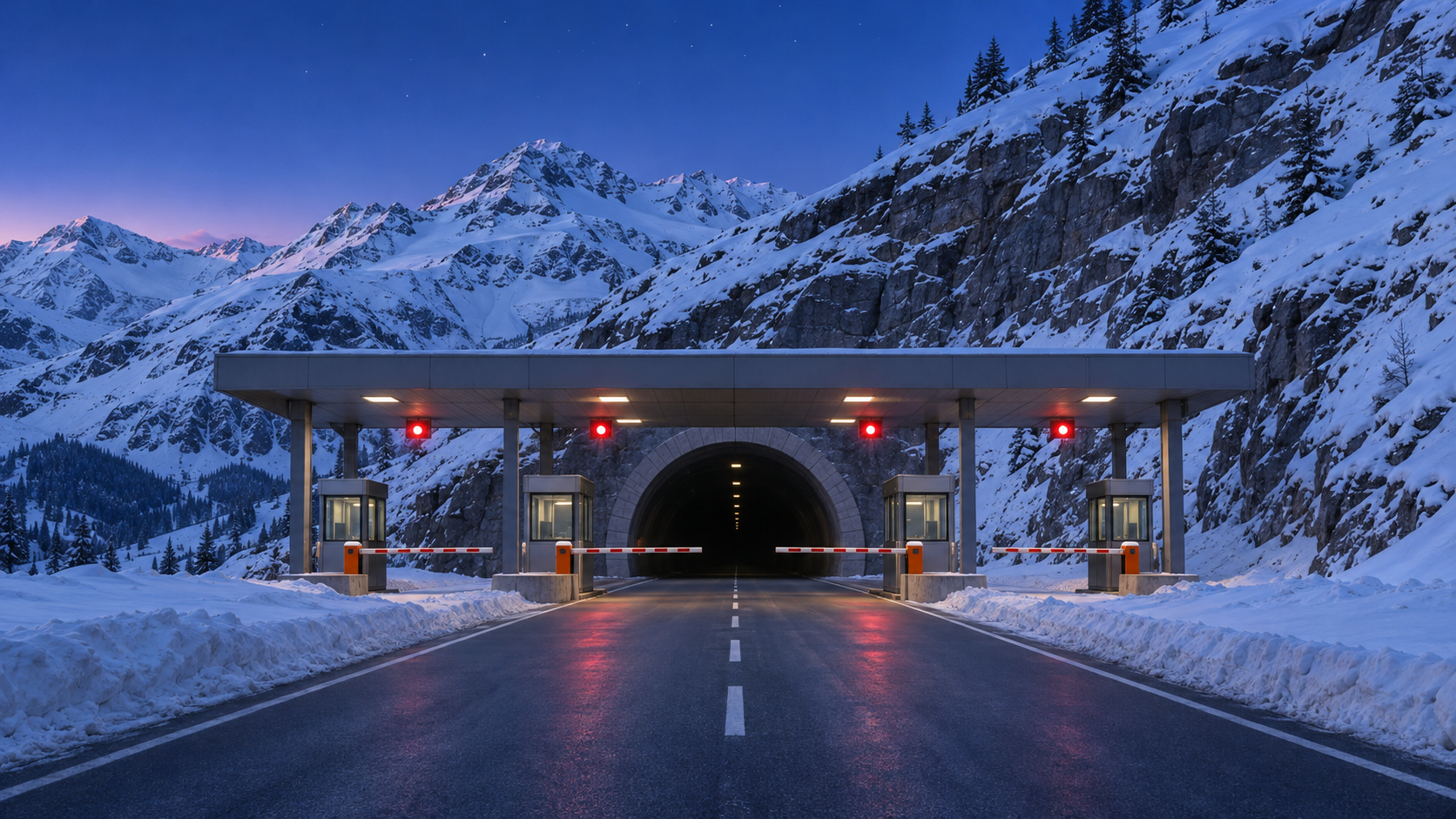
What are the rules inside the Mont Blanc Tunnel?
They are the driver's, and they are strict for a reason.
A fire in the tube on 24 March 1999 killed 39 people, the tunnel stayed shut until 9 March 2002, and the rules below came out of that. As a passenger you do nothing; the driver has to do five things:
- Speed. 50 to 70 km/h inside, with a maximum of 50 km/h at the French exit and 40 km/h at the Italian one.
- Distance. 150 metres, which is the gap between two blue lights on the wall, and at least 100 metres when traffic stands still.
- Overtaking. Forbidden, in a single tube with traffic in both directions.
- Snow chains. They can be carried, but not mounted: a vehicle with chains fitted cannot enter.
- Stopping. A stopped vehicle counts as an incident, and a driver who runs out of fuel pays €300 for the rescue.
Outside the tunnel the winter equipment rules differ by country. France asks for snow chains in the vehicle or four winter tyres from 1 November 2026 to 31 March 2027, according to the Chamonix tourist office, and the operator says Italy requires chains on board or snow tyres from 15 October to 15 April. Any vehicle on this road has to meet both.
Is the Mont Blanc Tunnel closed in 2026?
Not for weeks this year, but it shuts on set nights.
2026 has no autumn shutdown. In 2025 the tunnel closed completely for 15 weeks, from 1 September to 12 December, the second of two test works on the vault. This year the operator's calendar lists only night closures from Monday to Thursday, with the daytime left open. In the operator's words the tunnel is always open, and interruptions are normally programmed at night.
| When | Closed to all traffic |
|---|---|
| 16 to 19 November (Monday to Thursday) | 22:00 to 06:00 on 16, 18 and 19 November; from 20:00 on Tuesday 17 November |
| 24 November (Tuesday) | 18:00 to 06:00, twelve hours |
| 14 to 17 December (Monday to Thursday) | 22:00 to 06:00 each night |
| 18 to 31 December | No closure listed |
| January onward | Nothing published on 11 November |
Source: GEIE-TMB, October to December 2026 calendar of total closures, read 11 November 2026. The operator lists no nights of alternating one-way traffic.
Read it as a calendar of nights, not days. Friday, Saturday and Sunday nights are never closed on it, and the last closure is 17 December, so the Christmas and New Year changeovers fall outside it. January and February are a gap, not a promise: the operator publishes a quarter at a time, and the next calendar is not out.
Land at Geneva at 15:00 on Wednesday 18 November and the transfer is through the tunnel long before the 22:00 closure.
Land at 21:15 and it cannot be: the French portal is about 1h15 away, and the barrier is down from 22:00 until 06:00. Tuesday 17 and Tuesday 24 November are earlier still, at 20:00 and 18:00. A traveller in that position has three options, which are to wait for the morning, to sleep in the Chamonix valley or to take the Swiss way round described below, and the sensible time to choose is when you post the trip, not at the barrier.
Snow can stop it for an hour. On the French side the operator triggers controlled avalanches above the portal and the access ramps, and suspends traffic through the tunnel and on the ramps for about an hour while it does. An incident inside the tube is slower to clear: the operator's own FAQ says the disturbance after a stopped vehicle can be considerable.
The long-term plan is another matter. The 60-year-old vault needs rebuilding over about 6 km, with the real works after 2030, and in October 2025 the operator put two options forward: close the tunnel for three and a half years in one go, or for three and a half months every autumn for around 15 years. Haute-Savoie's elected representatives backed the phased option in November 2025, and the tourist board's report puts it at 17 years from 2030. That vote is a preference, not the decision. The Intergovernmental Commission and the two governments decide, and we found no announced decision on 11 November. Nothing in it changes a transfer this winter.
How long are the queues at the Mont Blanc Tunnel?
Mostly short, with peaks the operator publishes in advance.
The operator forecasts the wait hour by hour for every day of the quarter, in four bands: under 30 minutes, over 30 minutes, over an hour and over two hours. The wait it counts is the time to reach the toll barrier, outside the tunnel, and the forecast assumes a regular day, with no incident and no slowdown from border checks. Treat it as the best case.
| Day | Direction | Forecast wait |
|---|---|---|
| Saturday 19 December | France to Italy | Over 30 minutes from 10:00, over an hour from 12:00 to 16:00, over 30 minutes until 19:00 |
| Wednesday 23 December | France to Italy | Over 30 minutes from 10:00, over an hour from 14:00 to 16:00, over 30 minutes until 19:00 |
| Saturday 26 December | Italy to France | Over 30 minutes from 14:00, over an hour from 16:00 to 18:00, over 30 minutes until 20:00 |
| Wednesday 30 December | Italy to France | Over two hours from 17:00 to 19:00 |
Source: GEIE-TMB, forecast traffic calendar 2026, version of 15 October 2026. Saturdays 5 and 12 December and Sunday 27 December are forecast smooth in both directions.
Read the direction column against your trip. France to Italy is the way out from Geneva to Courmayeur, and the peak that matters is the Saturday before Christmas, from midday to four. Italy to France is the way home, and 30 December is the one forecast over two hours.
The Saturdays of January and February, the ones every changeover guide warns about, are not in the forecast yet. Our changeover Saturday guide covers how to time the flight around them in the meantime, and the operator's site and its TMB Mobility app show the live waiting time and the toll cameras on the day.
What is the alternative when the tunnel is closed?
From Geneva to Courmayeur it is the Great St Bernard Tunnel.
The Swiss way round follows Lake Geneva to Martigny, climbs to the Great St Bernard Tunnel, a road tunnel built to be usable every day of the year, and drops to Aosta before turning up the valley to Courmayeur. The pass road above it is normally closed by snow from October to May, which is why the tunnel matters in winter. The cost is distance and paperwork: the Swiss vignette (CHF 40, covered in our border crossings guide) and a separate tunnel toll, which we do not quote because the figures published for 2026 disagree and the operator's price page is not one we could read. The Swiss federal roads office publishes closures and works on the A21 up to the portal.
The Petit Saint-Bernard pass is a summer road, not a winter plan. The Fréjus tunnel, between Modane and Bardonecchia, is a different corridor and not a detour worth taking from Geneva.
For most trips the honest answer is not an alternative at all: it is a landing time that gets you through before 22:00 on a closure night.
Who pays the Mont Blanc Tunnel toll on a private transfer?
The carrier pays it, and most include it in the price.
The toll belongs to the vehicle, not to the passenger. TransferBnB's own FAQ says most carriers include tolls in their quoted price, and each offer shows what it covers before you accept it. What to look for is the vehicle: a car or a van up to 2 metres is class 1, a larger van is class 2, and a coach pays the class 3 toll.
Book a transfer through the Mont Blanc Tunnel
TransferBnB is a marketplace: you post the trip, verified local carriers who drive that road send offers, and you choose one. Put your flight number in the request, and if your landing falls on a closure night, say so there and ask which way the offer routes.
Start from the route page for your corridor: Geneva Airport to Chamonix or Chamonix to Geneva Airport. For Courmayeur and the Aosta Valley, our ski resort transfers page takes the request. The French Alps pieces to read first are the Geneva to Chamonix guide and the guide to which airport for the French Alps.
AI-generated images.
Frequently Asked Questions
How much does the Mont Blanc Tunnel cost for a car in 2026?
A car (class 1, up to 2 metres high and 3.5 tonnes) pays €55.50 one way entering from France and €56.40 entering from Italy in 2026, with a return ticket at €69.20 or €70.40. The two prices are one tariff with 20% VAT in France and 22% in Italy. Class 2, for taller vans and motorhomes, is €73.40 from France and €74.70 from Italy.
How long does it take to drive through the Mont Blanc Tunnel?
The crossing takes about 12 minutes. The tunnel is 11.6 km long, the speed window is 50 to 70 km/h and the barriers release one vehicle about every 8 seconds, so queues form at the toll booth outside and never lengthen the time inside.
Is the Mont Blanc Tunnel closed in 2026?
There is no long closure in 2026, unlike the 15 weeks of 2025. The tunnel is closed to all traffic on listed Monday to Thursday nights, normally from 22:00 to 06:00. Nine nights remain from 11 November: 16 to 19 and 24 November, and 14 to 17 December. No closure is listed from 18 to 31 December, and nothing is published yet for January onward.
Is a return ticket cheaper at the Mont Blanc Tunnel?
Yes. For a car going out through the French booth and home through the Italian one, two single tickets cost €111.90 and a return ticket bought on the French side costs €69.20. The ticket is valid until 23:59 on the seventh day after the day of issue, so a Saturday to Saturday week fits.
What is the speed limit inside the Mont Blanc Tunnel?
The limit is 70 km/h and the minimum is 50 km/h, with a maximum of 50 km/h at the French exit and 40 km/h at the Italian exit. Drivers keep 150 metres from the vehicle ahead, which is two blue lights on the wall, overtaking is forbidden and snow chains cannot be mounted inside.
What is the alternative to the Mont Blanc Tunnel from Geneva to Courmayeur?
The Great St Bernard Tunnel, from Martigny in Switzerland to Aosta in Italy, is the road to use in winter. It was built to stay open all year, while the pass above it is normally closed by snow from October to May. It needs the Swiss vignette and has its own toll, and it is a longer way round than through Mont Blanc.
Who pays the Mont Blanc Tunnel toll on a private transfer?
The carrier pays it at the booth, and on TransferBnB most carriers include it in the quoted price. Each offer shows what it covers before you accept it, and the class of vehicle decides the amount: €55.50 from France for a car, €73.40 for a larger van.
Will the Mont Blanc Tunnel close for years from 2030?
Possibly, but no final decision had been announced on 11 November 2026. The vault needs rebuilding over about 6 km, with the real works after 2030. Haute-Savoie's elected representatives backed phased closures of several months a year in November 2025, over a three-and-a-half-year closure, but the Intergovernmental Commission and the two governments decide.
Sources and Data
- GEIE-TMB, vehicles classification and tolls: the vehicle classes, the return ticket rules, VAT by side and the 2026 tariff sheet, read 11 November 2026.
- ATMB, Mont Blanc tunnel tariffs: the French-side tolls for classes 1 and 2, 2026.
- GEIE-TMB, October to December 2026 total closures and closures and forecasts: the closure nights and the hour-by-hour traffic forecast of 15 October 2026.
- GEIE-TMB, traffic regulations, FAQ and service charter 2026: speed, distance, crossing time, snow chains, avalanche control, the 1999 closure and 2002 reopening.
- Chamonix tourist office, road conditions: the French winter equipment rule for 2026/27.
- ICI Pays de Savoie, October 2025: the two scenarios for the vault works.
- Haute-Savoie tourist board, November 2025: the departmental choice of phased closures and the State's confirmation still to come.
- Wikipedia, Great St Bernard Tunnel: year-round use and the seasonal pass road; ASTRA, A21 Grand-Saint-Bernard: the Swiss federal roads office on the approach road.
- Wikipedia, Mont Blanc Tunnel: length, opening in 1965 and the 1999 fire.

