

By Lena Bauer · Last updated: November 2026 · 14 min read
In This Guide
- Quick Facts
- What is the Sella Ronda?
- How long it takes and when to start
- Clockwise or counterclockwise?
- Can an intermediate do it?
- If you miss the last lift
- The ski pass and its price
- When it opens in 2026/27
- Where to stay
- Val Gardena beyond the circuit
- Getting around without a car
- Getting there from the airport
- Book your transfer
- FAQ
The Sella Ronda is a 44 km ski circuit round the Sella group in the Dolomites. It crosses the Gardena, Sella, Pordoi and Campolongo passes and links Val Gardena, Alta Badia, Arabba and Val di Fassa. You ski 23 km of it and ride lifts for the other 21, in around six hours, on one Dolomiti Superski pass. Selva di Val Gardena is the natural place to start.
This guide covers how the circuit works, which way to ski it, what to do when the day runs late, the 2026/27 pass and season, which Val Gardena village to book, and how to get there from the airport. For the trip to every other Dolomites valley, see our guide to getting to the Dolomites.
Quick Facts: The Sella Ronda and Val Gardena (2026/27)
| Question | Short answer |
|---|---|
| Length | 44 km: 23 km skied, 21 km by lift |
| Passes | Gardena, Sella, Pordoi and Campolongo |
| Time needed | Around six hours; set off before 10:00, reach the last pass by 15:30 |
| Directions | Clockwise follows orange signs, counterclockwise follows green |
| Ski pass | Dolomiti Superski: €453 for 6 days, €89 for 1 day, adult high season |
| Season | Val Gardena and Sella Ronda lifts 4 December 2026 to 4 April 2027 |
| Best base | Selva di Val Gardena, for both directions |
| Nearest large airport | Innsbruck, 122 km and about 1 hour 45 minutes to Selva; transfers from €210 per vehicle |
Sources: Dolomiti Superski, Val Gardena tourist board, TransferBnB route pages, November 2026. Road times assume free flow.
What is the Sella Ronda?
It is a loop you ski in one day, round one mountain.
The mountain is the Sella group, a block of rock between four Ladin valleys: Val Gardena, Alta Badia, Arabba and Val di Fassa. Lifts and pistes join them over four road passes, the Gardena Pass at 2,121 m, the Sella Pass, the Pordoi at 2,239 m and the Campolongo at 1,875 m, so you can leave your hotel in the morning and come back to it in the afternoon having skied through all four.
The official length is 44 km, of which 23 km are pistes and 21 km are lifts, and both the lift consortium and the Val Gardena tourist board publish the same figure. Shorter numbers circulate, including a "26 km circuit"; both official boards give 44 km. The other number that matters is the ticket: the loop crosses several ski areas, so only the Dolomiti Superski pass covers it.
Four villages are the usual start points: Selva (Wolkenstein) in Val Gardena, Corvara in Alta Badia, Arabba in the Arabba/Marmolada area and Canazei in Val di Fassa. Colfosco, above Corvara, sits on the route too, and you finish where you began.
How long does the Sella Ronda take, and when should you start?
Allow around six hours, and start before 10:00.
That is the lift consortium's own figure, and it includes the lift rides, which take a large share of the day because almost half the distance is uphill on a chair or a gondola. Add lunch at a hut and a few stops for photographs and the six hours fill up quickly. The consortium's second rule is the one to plan the day around: reach the last pass by 15:30 at the latest, so you get back to your starting point in good time.
Weather is the other clock. In heavy snow and strong wind some lifts close, and a loop is only a loop while every link is turning. Check the lift status at breakfast, not at the top of the second pass.
Leave at 09:00 from Selva on a clear January day and you will be crossing the last pass with time in hand.
Leave at 11:00 after a slow breakfast and you will spend the afternoon watching the clock instead of the scenery.
Should you ski the Sella Ronda clockwise or counterclockwise?
Either works, and your base usually decides it.
Clockwise follows orange signs and counterclockwise (anticlockwise, in British usage) follows green. From Selva, clockwise starts on the Dantercepies lift up to the Gardena Pass, drops through Colfosco and Corvara, crosses the Campolongo to Arabba and returns over the Pordoi and the Sella Pass; the last lifts bring you down through Plan de Gralba and the Ciampinoi. Counterclockwise runs the same ring in reverse, starting with the Sella Pass.
The lift consortium names counterclockwise as its favorite. Beyond that, the guides disagree: some call clockwise the gentler day and some say the opposite, and no official source grades one direction harder than the other. The practical rule is simpler than the debate. Pick the direction whose first lift is nearest your hotel, ski it once, and do the other color on another day if you liked it.
Is the Sella Ronda hard? Can an intermediate do it?
A confident intermediate can, and that is who it is built for.
The consortium calls it a tour of medium difficulty that "requires a bit of stamina", and the Val Gardena board calls it ideal for skiers with average skills. What it asks for is pace: 23 km of pistes, four passes and a fixed afternoon deadline.
A skier who is still nervous on red runs will find the distance harder than any single slope. For a group of mixed ability, the honest test is the slowest skier, not the fastest, because the whole group has to make the last pass together.
What happens if you miss the last lift on the Sella Ronda?
You get home by road, and in winter that means a taxi.
Miss a connecting lift in the afternoon and you are in a different valley from your hotel, with the mountain between you. Some guides tell stranded skiers to take the bus over the passes. In winter there is not one: line 471, the bus over the Sella, Gardena, Campolongo and Pordoi, runs only in summer, so the way back is a taxi round the passes, and the passes themselves can close without warning.
The passes stay open in winter with winter tires or chains on board from 15 November to 15 April, but they can close without warning. Our Dolomites guide has the full winter road rules.
The cheaper fix is the timetable: if you are behind at lunch, turn back towards your own valley while every lift is still running.
Which ski pass do you need for the Sella Ronda, and what does it cost in 2026/27?
You need the Dolomiti Superski pass. There is no separate Sella Ronda ticket.
For 2026/27 the consortium's price list gives €453 for an adult 6-day pass in high season and €89 for an adult day pass in high season. Outside the peak, day prices move: the online price page showed €80 for a day pass in late November. The same pass opens 1,200 km of slopes and 450 lifts across the Dolomites, so a week in Selva can include days at Alta Badia, Val di Fassa or Arabba without a new ticket.
Families have their own product, Dolomiti Superski Family at €43 per day, which can be bought online for the first time this winter. A Val Gardena valley pass does not cover the circuit.
Read €453 and €89 as a ceiling, not a quote: the right figure for your dates is the one the consortium's calculator shows when you book.
When does the Sella Ronda open for 2026/27?
They open on Friday 4 December 2026.
The Val Gardena board says the lifts are scheduled to run until Sunday 4 April 2027, subject to change. Dolomiti Superski as a whole starts on 28 November 2026, which is why some guides give a late-November date for the circuit, but that is the consortium's first day elsewhere, not the Sella Ronda's.
Two offers bracket the season. Val Gardena's Super Premiere, 3 to 19 December 2026, gives 4 nights, a 4-day ski pass and 4 days' equipment rental for the price of 3 at participating hotels. The Dolomiti Springdays, from 13 March 2027 to the end of the season, give 7 nights for 6 and 6 ski days for 5, then 4 for 3 from 20 March. The Super Premiere needs a voucher from your host, and the Springdays run at participating hosts.
Mid-December has one fixed busy point: the Saslong World Cup, a super-G on Friday 18 December and a downhill on Saturday 19 December 2026, brings crowds to Val Gardena the week before Christmas.
Where should you stay for the Sella Ronda?
Selva, if the circuit is the point of the trip.
Val Gardena has three main villages on one valley road, Ortisei first from the motorway, then Santa Cristina, then Selva at the head of the valley under the Sella massif. Each suits a different skier.
Selva di Val Gardena
The circuit starts at the end of the street. At 1,563 m, Selva sits below the Sassolungo and the Sella massif, with the Dantercepies lift for clockwise and the Ciampinoi for counterclockwise both in the village, and the Val Gardena board calls it the ideal starting point. The catch is the main road, which carries the valley's through traffic. Plan de Gralba, 4 km up the road at 1,800 m, is a small cluster of hotels beside the lifts to the Ciampinoi.
Santa Cristina
The middle village, and the quiet one. At 1,428 m, Santa Cristina has a funicular to Col Raiser and Seceda, a chairlift to Monte Pana and a gondola to the Ciampinoi, which puts you on the Sella Ronda in one ride. A tunnel takes the through traffic round the village, which is also home to the Saslong, the World Cup downhill.
Ortisei
The town of the three, and the furthest from the circuit. Ortisei, at 1,236 m, has the widest choice of restaurants, bars and shops in the valley and a pedestrian-friendly center, plus gondolas to Seceda and the Seiser Alm (Alpe di Siusi). It has no lift towards the Sella Pass, so a Sella Ronda day starts with the ski bus up the valley. Choose it for a mixed group with non-skiers, not for four laps of the circuit.
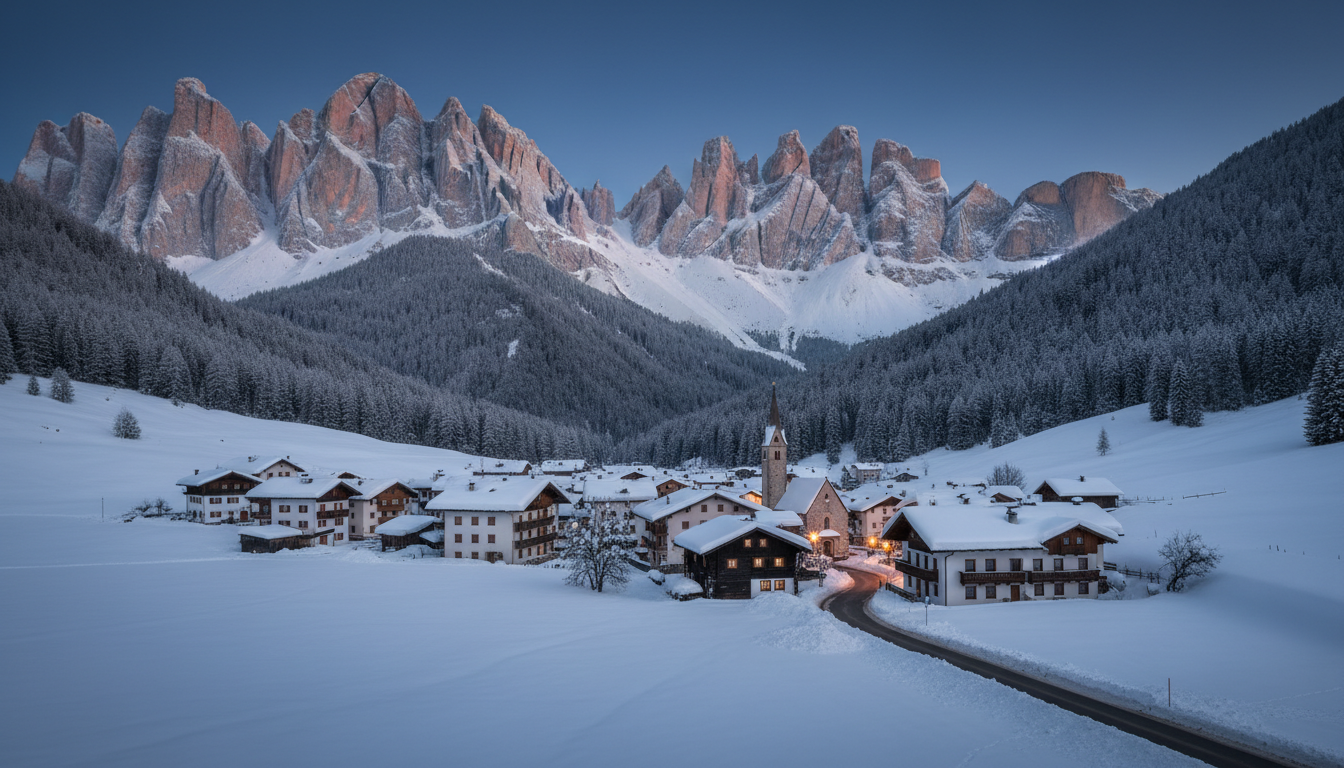
The other three valleys work too. Corvara and Colfosco in Alta Badia, Arabba, and Canazei in Val di Fassa all sit on the loop, and the same pass covers them. Our Dolomites guide compares the airports for Alta Badia and Val di Fassa.
Is Val Gardena good for skiing beyond the Sella Ronda?
Yes, and a week there is more than one circuit.
The Val Gardena board counts more than 500 km of connected slopes for Val Gardena and the Alpe di Siusi together. That figure belongs to the valley's connected area, not to Dolomiti Superski, whose 1,200 km covers the whole pass. Inside it sit three days that are not the circuit:
- La Longia - the valley's longest run, over 10 km from Seceda down to Ortisei with 1,273 m of drop.
- The Saslong - the men's World Cup piste at Santa Cristina.
- The Seiser Alm - the Alpe di Siusi slopes, reached by gondola from Ortisei.
With two days to spare, there is the Great War ski tour: 80 km round the Col di Lana, and the consortium recommends two days for it.
How do you get around Val Gardena without a car?
By ski bus, free with the Val Gardena Guest Pass.
A ski bus runs every 15 minutes between Ortisei, Santa Cristina and Selva, and ski buses in Selva serve the Dantercepies side from 4 December 2026 to 4 April 2027. The Val Gardena Guest Pass covers the valley's public buses. It does not cover the night bus or the Monte Pana and Saltria bus.
Once you are in Selva, a car mostly stays parked. The hard part is the first and last day.
How do you get to Val Gardena from the airport for a ski holiday?
Fly into Innsbruck if you can, or Munich for long-haul flights.
Innsbruck Airport is 122 km and about 1 hour 45 minutes from Selva in free flow, over the Brenner and up the valley from the Chiusa exit, and more than 60% of its 2025/26 winter passengers came from the UK. Munich Airport is 317 km and about 3 hours 50 minutes. Bolzano Airport is closer still, 50 km and 55 minutes, but it has 13 winter routes, one of them from the UK and none from the US. Some planners put Innsbruck at 1 hour 30 minutes door to door; 1 hour 45 is the free-flow time before any Saturday queue.
| From | To | Road | Private transfer from |
|---|---|---|---|
| Innsbruck Airport | Selva | 122 km, about 1 hour 45 minutes | €210 saloon, €295 van, €400 minibus |
| Munich Airport | Selva | 317 km, about 3 hours 50 minutes | €320 saloon, €450 van, €610 minibus |
| Munich Airport | Corvara, Alta Badia | 331 km, about 4 hours 10 minutes | €335 saloon |
| Munich Airport | Canazei, Val di Fassa | 338 km, about 4 hours 20 minutes over the Sella | €340 saloon |
Sources: TransferBnB route pages, November 2026. Prices are indicative per vehicle, one way; the final price comes from carrier offers.
Read down the price column by group size, not by row. From Innsbruck, eight skiers in a minibus start from €50 each and six in a van from under €50 each; from Munich, the same eight start from about €76 each. The Innsbruck saloon is €110 less on the from price than Munich's, and two hours of the arrival day.
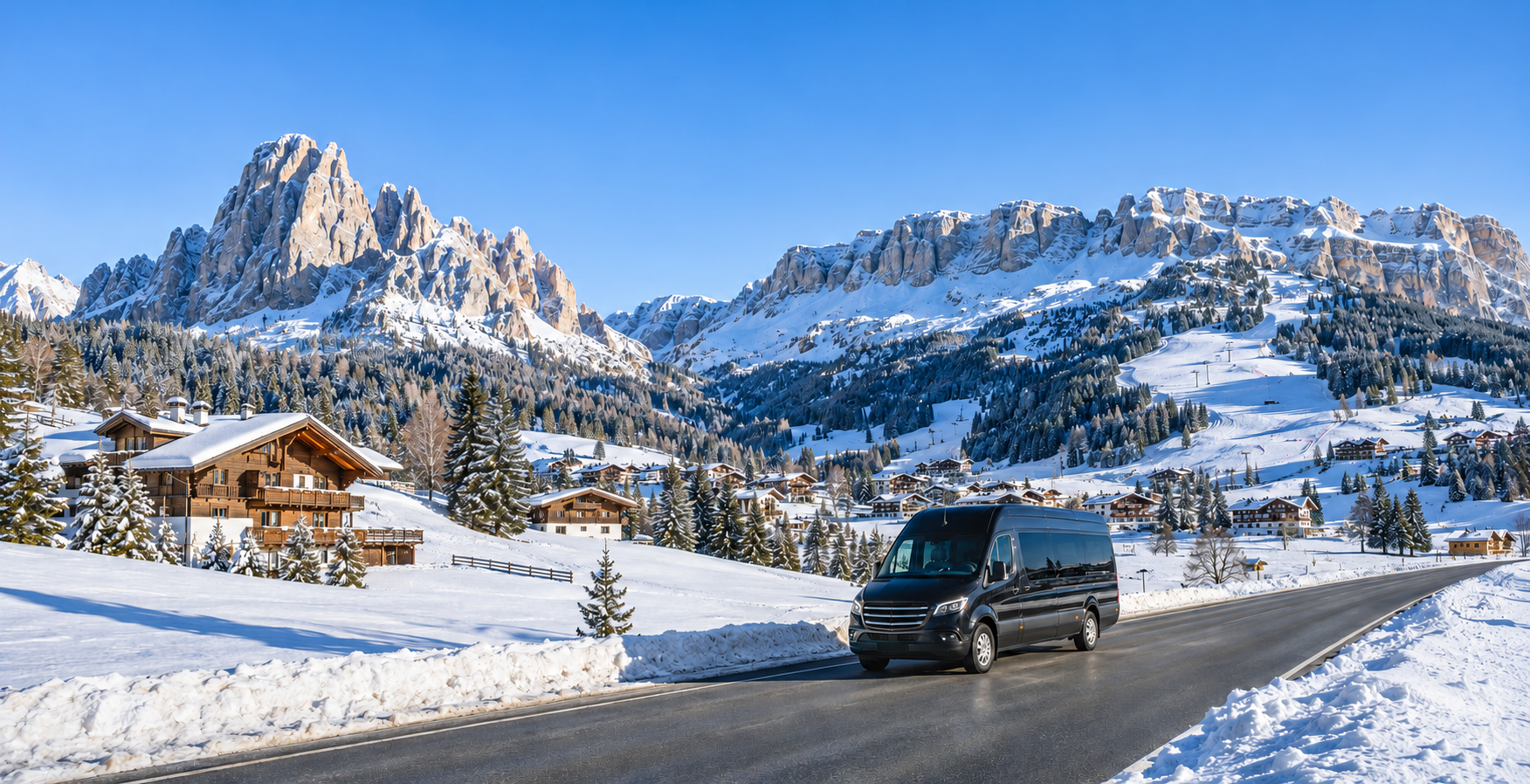
The train concession is real: there is a way in without a car. From Innsbruck Airport it takes about 3.5 hours with three changes, by bus F, two trains and bus 350, and from Munich Airport about 6 hours. With ski bags and a family, that is three changes with every bag, and the last useful connection from Innsbruck Hbf leaves at 18:19. A transfer collects you at arrivals and stops at your hotel in Selva, Santa Cristina or Ortisei, with every bag loaded once.
For a ski club or a group of twelve, say so in the request: the vehicle follows the head count and the number of ski bags, and two vans can split for different villages. Our guide to what fits in which transfer vehicle has the ski bag counts.
Book your transfer to Val Gardena
Post the trip once.
Give your flight, your hotel, the party and the ski bags. Verified local carriers send offers and you choose one. Whether you are two skiers with one bag each or a club of sixteen with boot bags, the request decides the vehicle.
From Innsbruck: Innsbruck Airport to Selva, and back from Selva to Innsbruck Airport. From Munich: Munich Airport to Selva and Selva to Munich Airport. Staying on the other side of the circuit: Alta Badia or Canazei.
AI-generated images.
Frequently Asked Questions
How long is the Sella Ronda?
The Sella Ronda is 44 km long: 23 km of pistes and 21 km by lift, round the Sella group over the Gardena, Sella, Pordoi and Campolongo passes. It links Val Gardena, Alta Badia, Arabba and Val di Fassa, and the lift consortium allows around six hours for the whole loop.
Should you ski the Sella Ronda clockwise or counterclockwise?
Either. Clockwise follows orange signs and counterclockwise follows green, and the lift consortium names counterclockwise as its favorite. No official source grades one direction harder. Pick the direction whose first lift is nearest your hotel: from Selva, clockwise starts on the Dantercepies lift and counterclockwise on the Ciampinoi side.
What time should you start the Sella Ronda?
Before 10:00 for a loop of around six hours, and reach the last pass by 15:30 at the latest, so you get back to your starting point in good time. In heavy snow or strong wind some lifts close, so check the lift status before you set off.
What happens if you miss the last lift on the Sella Ronda?
You end up in another valley and go back by road, and in winter no bus crosses the passes, because line 471 runs only in summer. The way home is a taxi round the mountain. If you are behind schedule at lunch, turn back towards your own valley while the lifts are running.
Which ski pass do you need for the Sella Ronda?
The Dolomiti Superski pass; a valley pass does not cover it. For 2026/27 an adult 6-day pass costs €453 and a day pass €89 in high season, with lower dynamic prices on quieter days, and the same pass covers 1,200 km of slopes and 450 lifts across the Dolomites.
When does the Sella Ronda open in 2026/27?
The Val Gardena lifts and the Sella Ronda open on 4 December 2026 and are scheduled to run until 4 April 2027, subject to change. Dolomiti Superski starts its season on 28 November 2026 in other areas. The Saslong World Cup race weekend of 18 and 19 December brings crowds to Val Gardena.
Where is the best place to stay for the Sella Ronda?
Selva di Val Gardena, where lifts for both directions start in the village. Santa Cristina is quieter, with a gondola to the Ciampinoi. Ortisei has the widest choice of restaurants and shops but no lift towards the circuit, so the day starts on the ski bus. Corvara, Arabba and Canazei also sit on the loop.
How do you get from the airport to Selva di Val Gardena?
Innsbruck Airport is closest of the large airports: 122 km and about 1 hour 45 minutes, with a private transfer from €210 per vehicle. Munich Airport is 317 km and about 3 hours 50 minutes, from €320. By train and bus it takes about 3.5 hours from Innsbruck with three changes; a transfer drives to the hotel door with the skis.
Sources and Data
- Dolomiti Superski, Sellaronda - length, directions, timing and the Great War ski tour, 2026/27.
- Dolomiti Superski, 2026/27 press release - ski pass prices and investments, September 2026.
- Val Gardena tourist board, Sellaronda - length, passes and start time.
- Val Gardena tourist board, ski resort - 2026/27 season dates, slopes and La Longia.
- Val Gardena, Super Premiere and Dolomiti Springdays - 2026/27 offers.
- Val Gardena, bus schedule and holiday guide - ski buses and the Guest Pass, 2026/27.
- Dolomiti.it - start points and route order.
- Saslong Classic - World Cup race dates, December 2026.
- Val di Fassa, bus service - line 471 in summer only.
- IDM South Tyrol, mountain passes and Arabba, traffic - winter status and equipment rules.
- Independent ski guides and village pages - village heights and lift access, 2026.
- TransferBnB route pages - transfer prices, distances and times, November 2026.

